AI was supposed to free us up so we'd finally have time to be creative. The research tells a different story: with AI, our ideas get better, but also more alike. What we outsource, we unlearn. And exhaustion is rising. As a doctor and art therapist, I look at what the flood of AI content is doing to our creativity, our health and our teams. And why it's worth making things ourselves again.
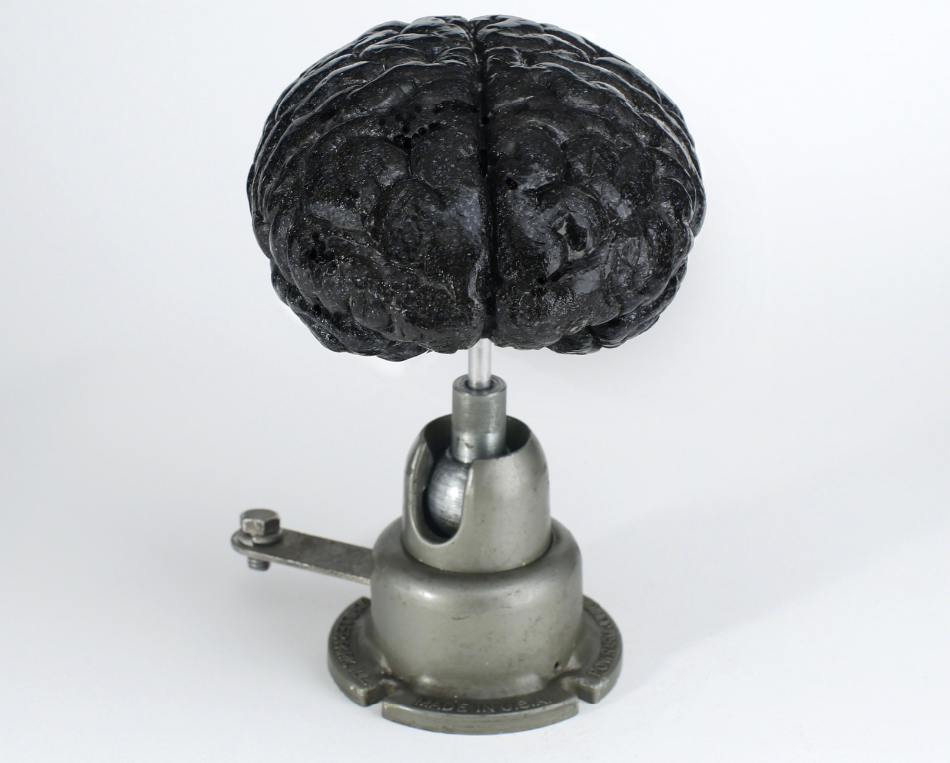
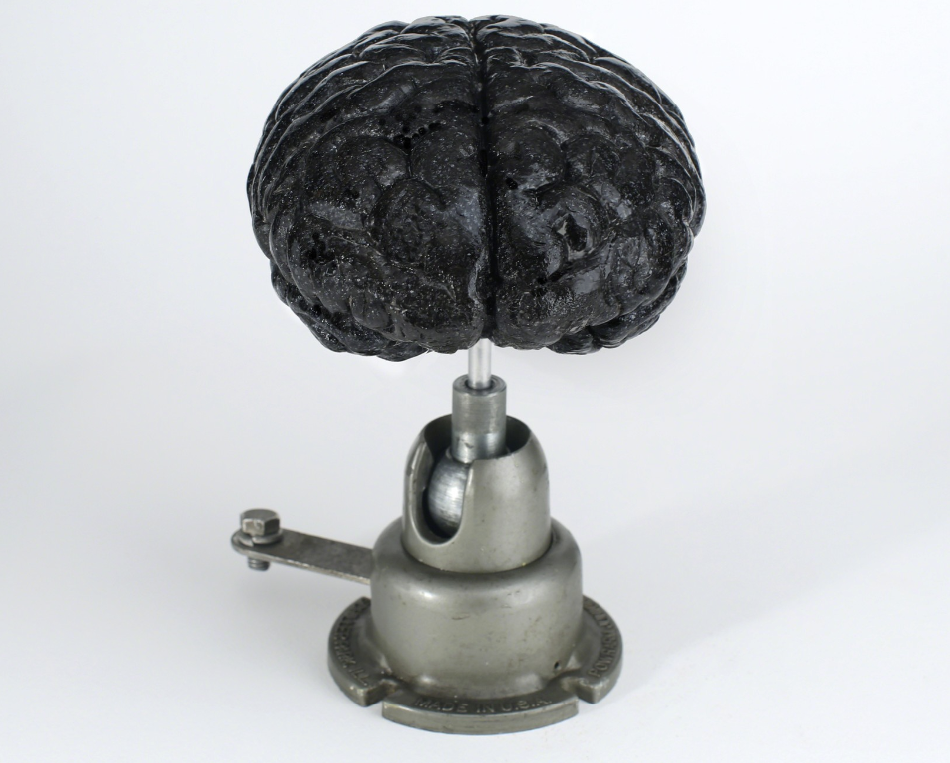
Emilio Chapela (2016), “Artificial Intelligence”
Creative expression used to be about sitting in silence with your subconscious, about playing with different ideas in your head, about allowing for your mind to wander. Then productivity culture turned it into a race against a million other creatives and their ideas - which let’s face it often seem so much more brilliant, so much more innovative. Especially if you are a professional creative - meaning you are making a living out of your art - you probably know how sweaty you end up after such a race. Then AI came in and it promised us relief. To make our lives easier. To make our workflow more productive and to gift us the one thing we need most: time. Because it was gonna take the tedious work off our plates so we'd finally have time for our actual creativity. But science tells a different story.
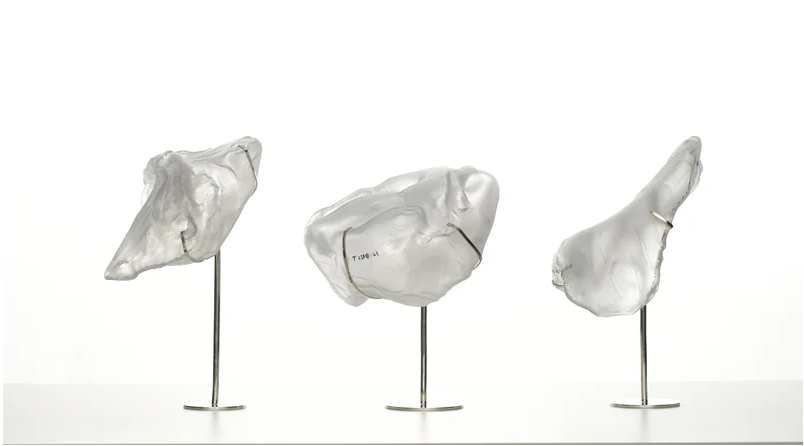
Nan nan Zhang (2024), “Cultural Relics of the Artificial Intelligence Era”
AI and Creativity: Individually Better, Collectively the Same
In 2024, Anil Doshi and Oliver Hauser published an experiment in Science Advances where almost 300 people wrote short stories. One group could get ideas from GPT-4 the other one had to come up with the stories themselves. The result: the AI-assisted stories were rated as more original and better written, especially for people who usually struggle with writing. This sounds really compelling, doesn’t it?
But here comes the downside: the different stories were much more similar to each other. So while the individual profited from the use of AI, the totality of the stories sounded more or less the same. The authors call it a social dilemma: each individual is better off, but together we produce a much narrower world.
A study by Barrett Anderson and colleagues found the same pattern in brainstorming. With ChatGPT, people came up with more ideas, but the ideas of different people converged. And, as an art therapist, I find this especially telling: participants felt less responsible for their own ideas.
So what happens to our creativity when we outsource the authorship? We inevitably lose our self-efficacy. Because if AI is doing the work, how can we conclude that we as an individual can actually make a difference in this world?
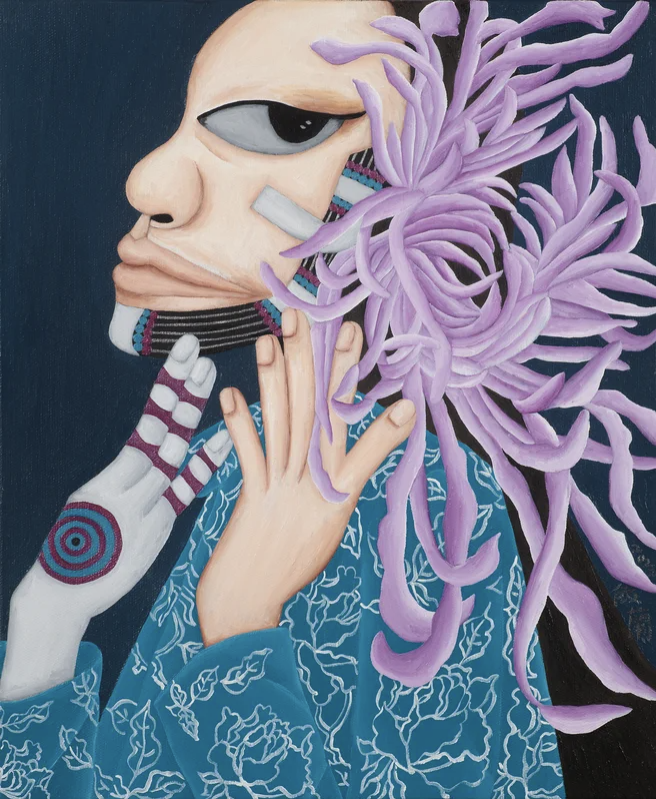
Liu Yi-Lan (2022), “Artificial Intelligence No.9”
Does AI Make Us Think Less? What We Outsource, We Unlearn
At the MIT Media Lab, Nataliya Kosmyna and her team looked inside students' brains while they were writing, using EEG, over four months. Those writing without any tools showed the broadest brain connectivity. Those using ChatGPT showed the weakest. After the first session, 15 out of 18 ChatGPT users couldn't quote a single sentence from the essay they had just written. In the no-tools group, it was 2 out of 18. The researchers call it "cognitive debt": we save effort now and pay for it later with less critical thinking, more vulnerability to manipulation, and less creativity.
But isn’t critical thinking the essense of creativity? And isn’t it the purpose of the creative to question the status quo and come up with something new? Something more compelling then what we have now? If you feel the impulse to shy away from the creative’s responsibility I wanna stop you right there. Because you are the creative I’m talking about, even if you find your day to day job dull and you have never produced a famous painting in your life. Every human is born with creativity. Being creative is an innate part of our human experience.
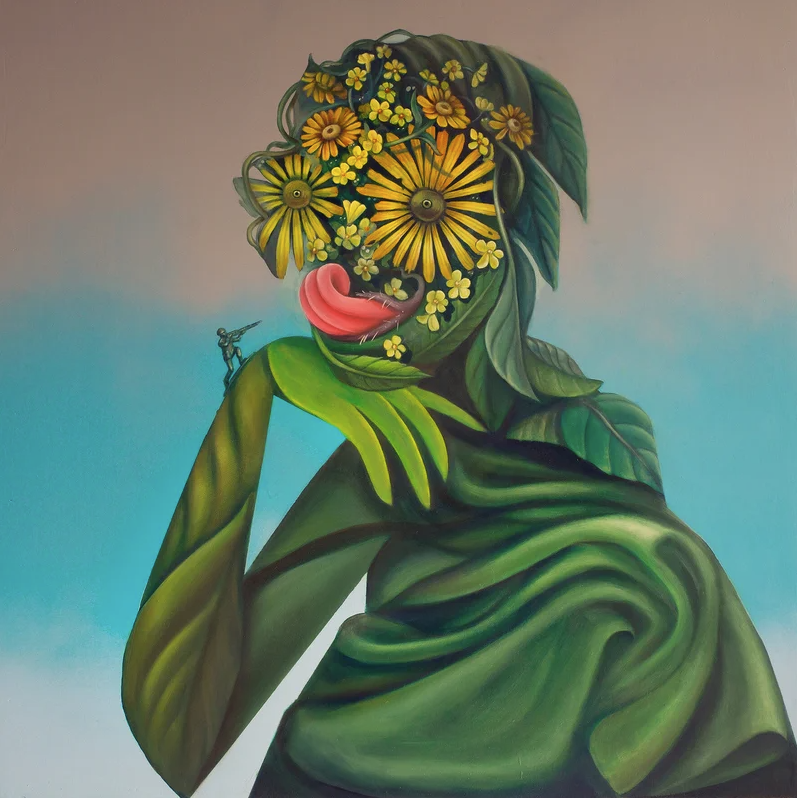
Natasha Lelenco (2022), “Stupid Game I - Toy Soldier Botanical Portrait”
AI-Generated Content: Why the Margins Disappear First
By some estimates, more than half of newly published English-language articles online are now mainly AI-generated. In 2024, a team led by Ilia Shumailov showed in Nature what happens when machines learn from machines. They call it "model collapse": when AI models are trained on AI content, what disappears first are the rare, the unusual, the margins.
Let’s take a look at what that means to us as individuals. Because if we want to understand the work by Ilia Shumailov we need to ask a very important question: Whose stories, languages and aesthetics live at the margins? When a culture increasingly feeds on itself, the first perspectives to vanish are the ones that already have to fight to be seen. Homogenisation isn't neutral. It's political.
Marginalization comes with extinction. Underrepresented communities already fall under the radar. And instead of getting supported by AI, their aesthetics, their voices and stories are now pushed aside even more. AI might be a great tool to increase our productivity but it also leaves some of us behind.
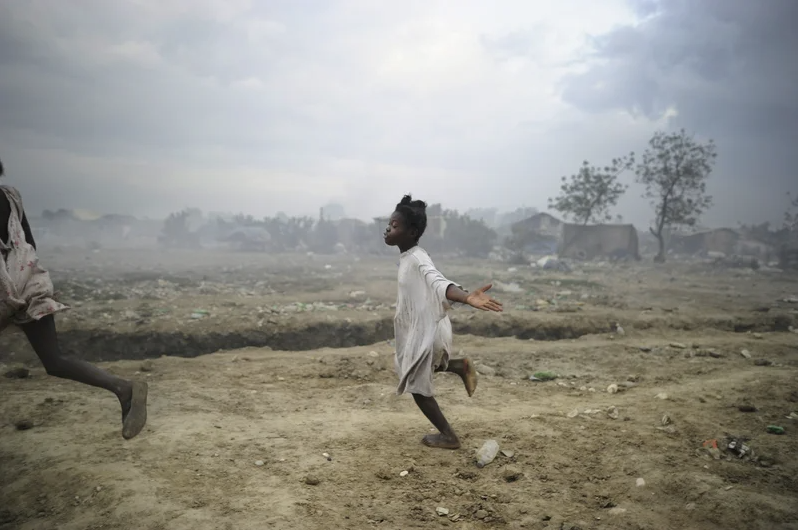
Antonio Bolfo, “Cite Soleil 2”
Creative Burnout in the Age of AI
At the same time, the pressure is exploding. In a survey by the Upwork Research Institute, 96% of executives said they expect AI to boost productivity. But if productivity is rising, so are the expectations. 71% feel burned out, among Gen Z, it's even 83%. In the face of the endless amounts of images, texts, presentations etc. our own creativity often falls behind. We are not just expected to be innovative and fast anymore we are expected to be as fast as AI. It’s already overwhelming to be flooded with the endless output of content on social media and now that big chunks of it are the result of a machine, we can feel even more behind. But the stress caused by this is not just a psychological one. AI creation actually threatens the existence of many creatives. According to the Society of Authors, a quarter of UK illustrators have already lost work to AI. And anyone who works creatively suddenly has to compete with a machine that never gets tired, never doubts, never sends an invoice. Exhaustion can come from either an unmanageable amount of work or a lack of gratification. And it seems like AI affects both levels.
But what if we are just using it the wrong way? What if the problem is that we are trying to compete with the never tired AI in the first place and not just let the AI work more efficiently for us?
Even if we use AI as an assistant, that is supposed to reduce our admin stuff it can still cause more harm than good. 77% of employees said AI has actually increased their workload. Researchers from Stanford coined a new word for it: "workslop," AI output that looks like work but doesn't move anything forward. That can be the perfectly layouted presentation that lacks an original thought, the ten page memo that doesn’t give any new information after page three, or a friendly e-mail that doesn’t answer any questions. And workslop is expensive. Because even if it makes the life of the person producing it easier for a moment, the person receiving it has to edit. That can cost up to 2 hours of extra work. While we are looking at numbers, this amounts to approximately 186 US-Dollar per person per months, or 9 Mio dollar per year. 40% of respondents had received workslop in the past month and half of them thought less of the colleague who sent it. They took them as less creative or even less capable.
Creative professionals are hit twice as hard. According to the Society of Authors, a quarter of UK illustrators have already lost work to AI. And anyone who works creatively suddenly has to work against a machine that never gets tired, never doubts, never sends an invoice.
In my practice, I see this as a particular kind of exhaustion. It’s designers finding their work irrelevant. It’s comedians getting their jokes stolen by AI and watching how artificial comedians get ten times the amount of likes for the work they haven’t even produced. It’s copy writers asking why they get up in the morning. It’s clients sitting in front of a white sheet, terrified to produce anything less than perfect. I call it creative burnout.
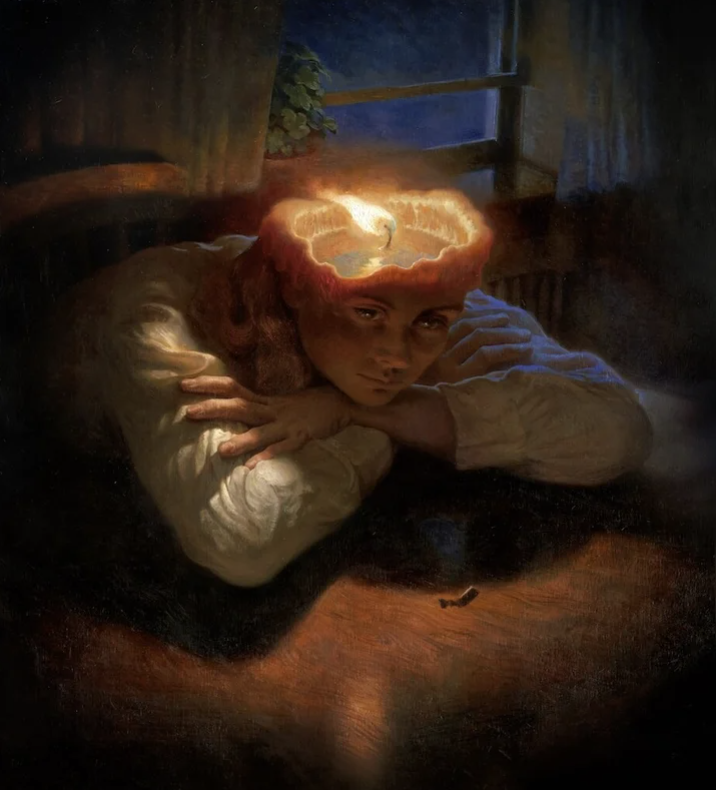
Miles Johnston (2025), “Burnout”
The Cost of Disengaged Employees
But what happens to our inner world if a huge chunk of our work consists of content we created with AI? How do we find meaning in a world in which we take part less and less and instead hand over the steering wheel to a software? Loosing attachment to a product is one thing, but losing our agency in what we spend the most hours of our day with sounds terrifying to me. In April 2026, Gallup reported that only 20% of employees worldwide are engaged. Disengagement costs the global economy around 10 trillion US dollars a year. In Germany, only 10% of employees feel strongly attached to their employer, and quiet quitting costs the German economy between 119 and 142 billion euro a year.
When quiet quitting turns into actual quitting, it gets even more expensive: according to Gallup, replacing an employee costs between half and twice their annual salary. And according to the WHO, depression and anxiety cost the global economy around 12 billion working days and nearly 1 trillion US dollars every year.
Gallup's CEO said it himself: businesses are investing heavily in AI, but the results aren't showing up in the bottom line. I don't think the answer is in the next software update. I think it's sitting in your team.
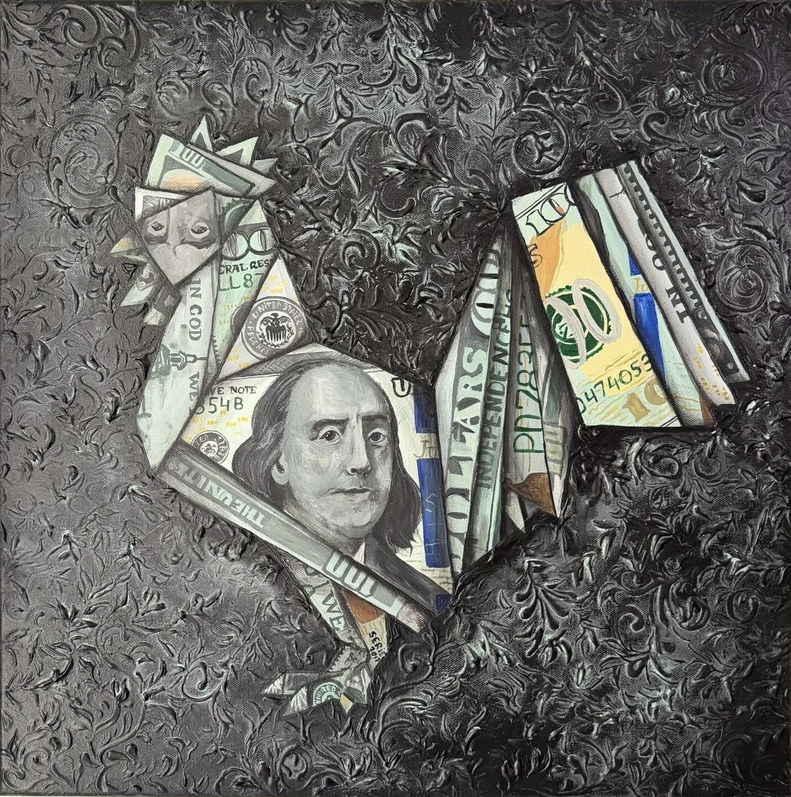
Helena Bunina (2026), “20×20 in - Too Proud to Fall / Money, Dignity and Inner Strength”
Employee Wellbeing Pays Off: Happier Teams Are More Productive
There’s a reason to care for your team: investing in people pays off. A research team from Oxford showed at British Telecom that one extra point of happiness on a scale from 0 to 10 means about 12% more productivity, and close to 20% for complex tasks. Deloitte calculates that every pound invested in mental health returns an average of £4.70 in the UK. And creativity researcher Teresa Amabile showed as early as 2005 that positive mood comes before creative thinking, with a delay of up to two days.
In order to be creative we have to feel safe and happy first.
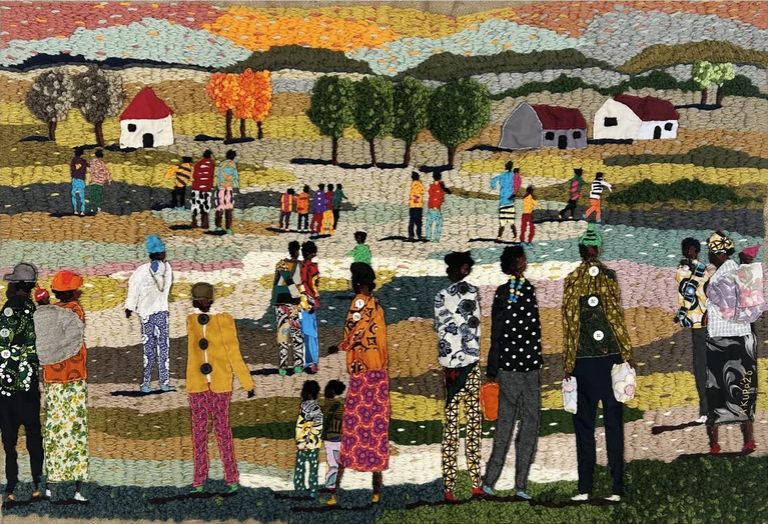
Asanda Kupa (2026), “Provision of love and wellbeing”
How to Protect Creativity: More Human, Not Less AI
I'm not against AI. I use it every day. But I think we're confusing output with expression.
Creativity is not just a product. It's a relationship: with ourselves, with the medium, with others. It needs emptiness, boredom, mistakes. It needs hands and human brains. And it needs a heart.
We know how beneficial creative expression is for our stress-levels, our mood, our overall health and our relationship to this world. The importance of getting your hands dirty cannot be denied. So why not use these findings to help humanity feel human again? If we are all born as a creative being, then why should we die as a being that handed over all the creative effort to AI?
And one more thing: when people believe a picture was made by a human, they find it more profound and more valuable, even when it was actually made by AI. What that tells us? We don't just respond to the image. We respond to the effort, the story, the relationship behind it. To what it takes to bring something in this world that has never existed before? To the emotions it evokes in us because it’s filled with emotions itself.
AI might be faster, might be more. AI might take our jobs and leave us feel less than. But there’s one thing AI cannot steal from us: we are feeling beings. Our emotions make up a big part of the story we are writing everyday when we walk through this life. It’s how we engage with others. How we care. And how we can represent that in our creative work. Never forgot that every great idea or work of art could only every be brought to life because it was created by the person who made it. Creative expression doesn’t work without the individual story and situation of an individual person. It takes you to make whatever you need to leave behind in this world.
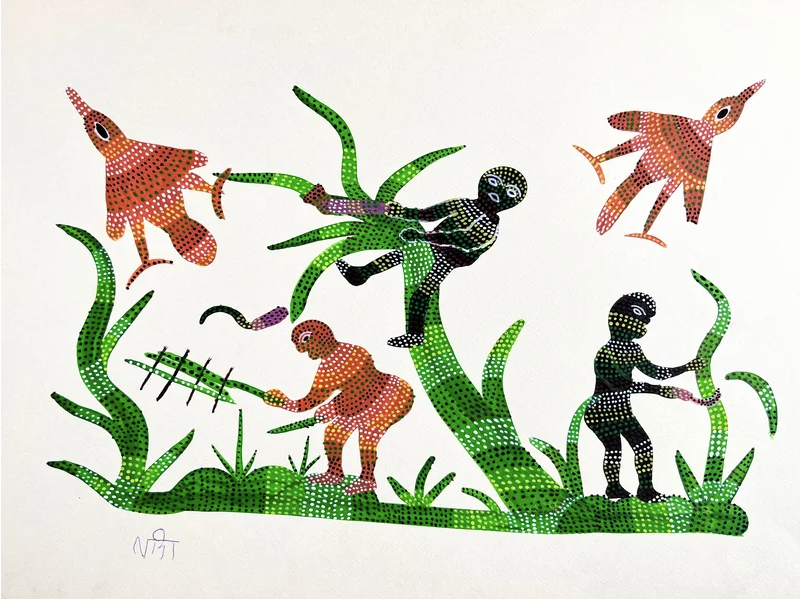
Lado Bai, “Ritual & Creativity, Early 21th century”
Boosting Team Creativity: Three Things to Do Tomorrow
1. Think first, prompt second. The first round of ideas belongs to humans. Ten minutes, pen and paper, before anyone opens a tool.
2. Create analogue islands. Twenty minutes in the monthly meeting where something gets made by hand. Not for Instagram, not for the slide deck. Just because.
3. Celebrate the unfinished. A culture that welcomes bad first drafts is a culture where good second drafts happen.
If you are looking for a space where your creativity can unfold without any technology involved come visit my workshops.
Art doesn't have to be good. It has to be ours.
If you'd like to explore what this could look like for your team, get in touch: hello@thuliwolf.com
Recoursses:
AI and creativity - Doshi & Hauser (2024): Generative AI enhances individual creativity but reduces the collective diversity of novel content.
Science Advances. https://doi.org/10.1126/sciadv.adn5290 - Anderson, Shah & Kreminski (2024): Homogenization effects of large language models on human creative ideation. https://doi.org/10.1145/3635636.3656204 - Kumar et al. (2025): Human creativity in the age of LLMs.
https://doi.org/10.1145/3706598.3714198 - Kosmyna et al. (2025): Your brain on ChatGPT (preprint).
https://doi.org/10.48550/arXiv.2506.08872 - Lee et al. (2025): The impact of generative AI on critical thinking.
https://doi.org/10.1145/3706598.3713778 - Shumailov et al. (2024): AI models collapse when trained on recursively generated data.
Nature. https://doi.org/10.1038/s41586-024-07566-y - Gallup (2026): State of the Global Workplace.
https://www.gallup.com/workplace/349484/state-of-the-global-workplace.aspx - Upwork Research Institute (2024): From burnout to balance. https://www.upwork.com/research/ai-enhanced-work-models - BetterUp Labs & Stanford Social Media Lab (2025): Workslop.
https://www.betterup.com/workslop - WHO & ILO (2022): Mental health at work.
https://www.who.int/publications/i/item/9789240057944 - Bellet, De Neve & Ward (2024): Does employee happiness have an impact on productivity? Management Science. https://doi.org/10.1287/mnsc.2023.4766 - Kaimal, Ray & Muniz (2016): Reduction of cortisol levels following art making. Art Therapy.
https://doi.org/10.1080/07421656.2016.1166832 - Bellaiche et al. (2023): Humans versus AI: Whether and why we prefer human-created artwork. https://doi.org/10.1186/s41235-023-00499-6